Evidence-based assessment and treatment for tinnitus and sound sensitivity
There is a treatment path for tinnitus.
Tinnitus impacts your life and so does the right treatment. The Blue Mountains Tinnitus Clinic provides evidence-based assessment and tinnitus treatment plans for your ears, your brain, and quality of life.
Serving the Blue Mountains and Sydney.
When tinnitus starts affecting the things that matter most to you, it’s important to know your options for treatment that come from evidence-based guidelines.
The Blue Mountains Tinnitus Clinic helps you move forward with care that brings together audiological expertise with tinnitus education, Cognitive Behaviour Therapy for tinnitus (CBT), and sound therapy options. As a tinnitus therapy provider, we provide all treatment.
This combination helps settle tinnitus into the background, so you can fully enjoy the life you love.
Tinnitus is a symptom that is treatable.
Tinnitus is a symptom of ear and brain activity.
The Blue Mountains Tinnitus Clinic addresses the sound experience of tinnitus, your brain’s reaction to it, and the thinking processes that drive it, because your brain is where the distress actually lives.
Treatment promotes the process of habituation, which is your brain’s natural capacity to disengage from tinnitus and stop treating the sound as a threat. Over time, with your commitment to treatment, distress lessens and your quality of life improves.
Scientific evidence is at the core of every treatment plan at the Blue Mountains Tinnitus Clinic. Treatment options follow the evidence-based stepped care pathway, which means the level of support you receive matches where you are right now.
All treatment is evidence-based, integrating assessment, structured Cognitive Behavioural Therapy for tinnitus (CBT), sound therapy, and referrals for audiological assessment and medical review where needed.
AUDIOLOGY CLINIC SPECIALISING IN THE ASSESSMENT AND TREATMENT OF TINNITUS & HYPERACUSIS
Services available via telehealth or in-person in the Blue Mountains, NSW
Led by Gabrielle Bray, Accredited Audiologist (AAudA) with Audiology Australia, and counsellor with the Australian Counselling Association (ACA-registered), with over 25 years’ experience in clinical audiology, hearing rehabilitation and tinnitus counselling.




Common impacts of tinnitus
Our assessment and treatment process
01 | Assessment
We start with a thorough tinnitus assessment to understand how it’s affecting your sleep, mood, and quality of life. You receive a written formulation letter, and follow-up call to discuss your outcomes and any recommended next steps. A report is sent to your treating doctor also.
02 | Treatment plan
Based on your assessment outcomes, we recommend a plan matched to the level of impact your tinnitus is having. Options range across our stepped-care programs and, where suitable, sound therapy or the Neuromonics program for tinnitus habituation.
04 | Outcomes and review
At the end of your treatment, we review your outcomes using the same measures taken at your assessment. This shows how things have changed over the course of treatment, and with your consent we send a summary report to your treating doctor and/or specialist.
03 | Between sessions
Between sessions, you continue your treatment plan through a guided and secure easy to use app with access to text-based check-ins with your clinician. This enhances your progress and allows us to adjust your plan as your tinnitus and daily life change.

Treatment is matched to the way tinnitus impacts you, from early support to more structured care depending on your assessment outcomes.
EVIDENCE-BASED STEPPED CARE FOR TINNITUS
Tinnitus treatment plans designed around your assessment & needs
Tinnitus foundations
A guided treatment plan for people with mild tinnitus, to understand what’s happening and start building a calmer relationship with the sound.
For mild tinnitus impact
CBT for
tinnitus
Structured cognitive behavioural care for more persistent tinnitus impacts, drawn from the strongest evidence base in tinnitus care.
For moderate to significant tinnitus impact
Habituation plan
A guided treatment plan for more established tinnitus, using sound-based strategies and practical skills to help settle it into the background.
For mild to moderate tinnitus impact
Neuromonics treatment

Neuromonics is a personalised sound therapy treatment protocol for tinnitus that has been used clinically for around twenty years and studied in trials across Australia and the United States.
The treatment is designed to support the process of habituation to tinnitus and its impact on your life. It uses a personalised acoustic neural stimulus delivered through an app, with modified Cognitive Behavioural Therapy (CBT) techniques, and ongoing guidance from your clinician at the Blue Mountains Tinnitus Clinic, Gabrielle.
Neuromonics uses clinically prescribed music adjusted to your own hearing profile through an app at home, with regular clinical support.
This program is designed for specific hearing and tinnitus presentations, hence all potential patients require an initial tinnitus and lifestyle assessment to determine if this suits your needs.
At the clinic, we have two intakes per year. The next intake is in February 2027.
To understand if this program is suited to your tinnitus impact, please book your initial Tinnitus & Lifestyle assessment via the button below.
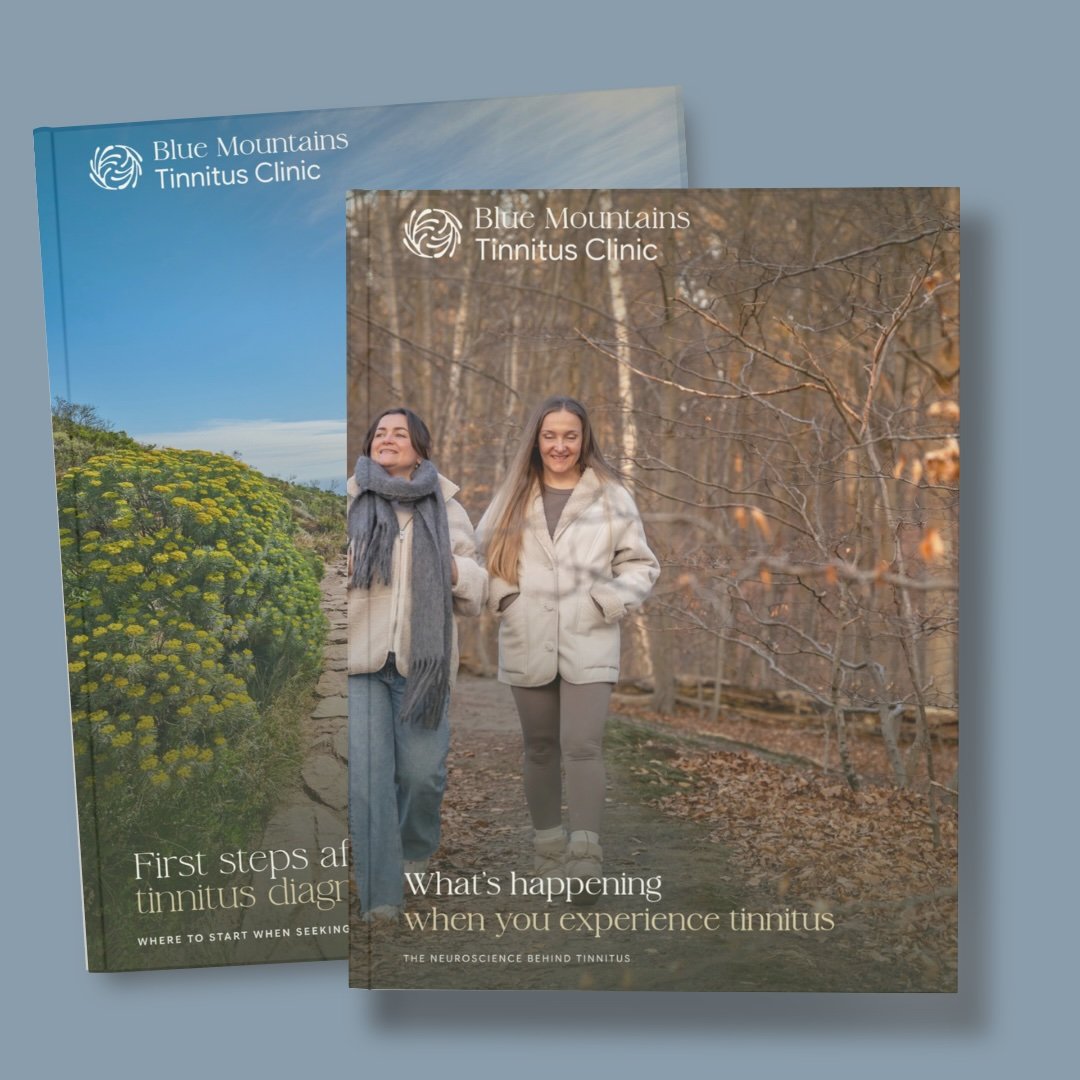
Your assessment includes: Initial session, formulation letter and booklet, follow-up appointment with treatment recommendation, and report to your doctor/s.

Hyperacusis: sound sensitivity assessment & treatment support
If you live with hyperacusis, everyday sounds can feel too loud or hard to tolerate. They may even seem painful. Like tinnitus, this is a change in how the brain responds to sound. The clinic provides assessment & treatment to build your tolerance gradually.
Your assessment is the first step: we get to understand your sound sensitivity, and plan the right support. Assessment is $400, ($350 for pension/seniors card/student). There is no obligation to choose treatment after this assessment, and your clinician will help guide you with this decision.
For more detail, see the hyperacusis treatment plan section on our treatments page.
DOWNLOAD FOR FREE
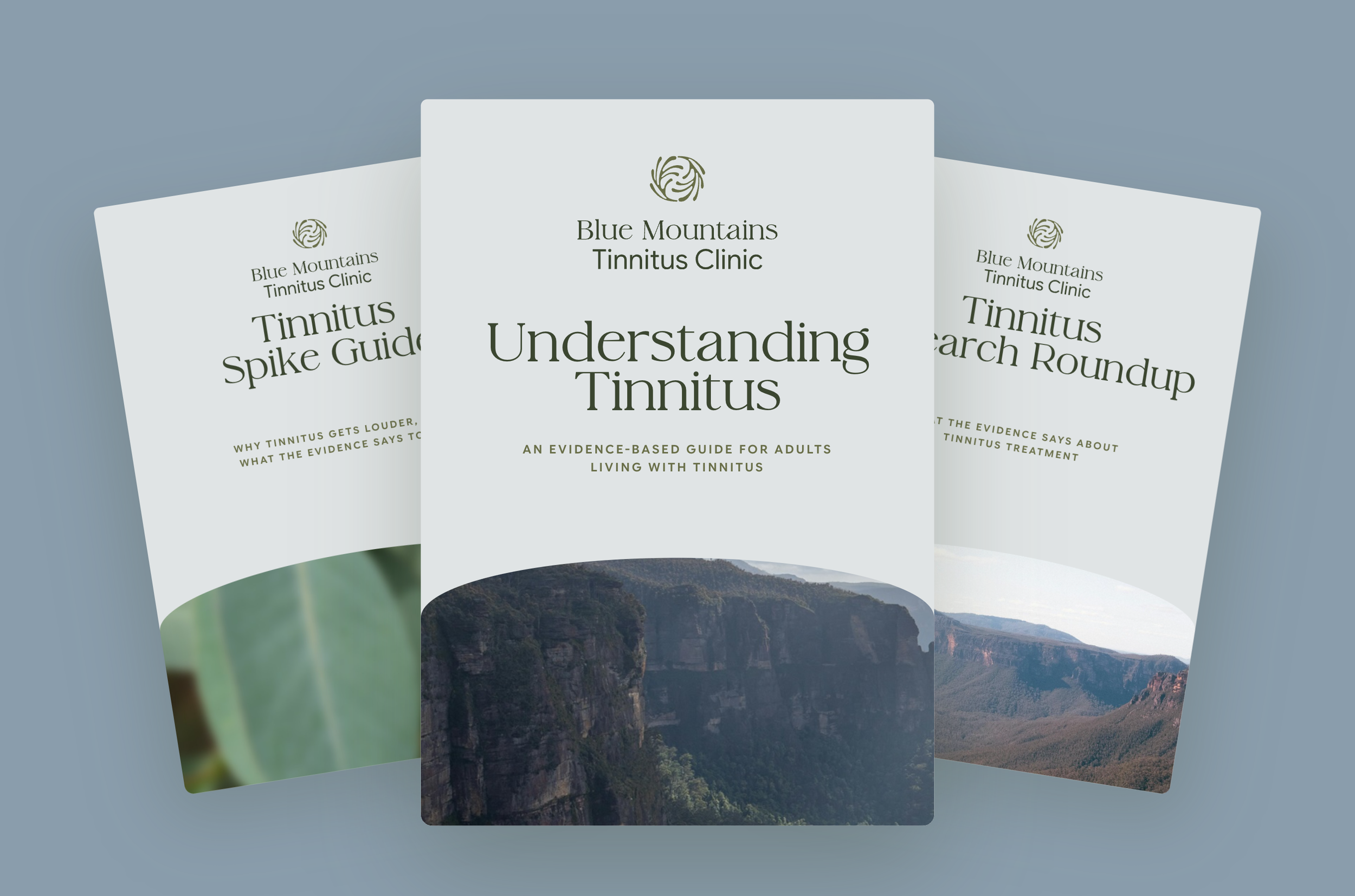
Tinnitus resource pack
Everything you need to understand tinnitus: Tinnitus Guide ebook, Spike Guide, Research roundup, and the tinnitus couch monthly newsletter. Unsubscribe at any time.

Meet Gabrielle
Gabrielle Bray is the owner of the clinic and is a dual-qualified Clinical Audiologist and ACA-registered Counsellor with over 25 years of clinical experience in hearing and tinnitus rehabilitation. She founded the Blue Mountains Tinnitus Clinic because she kept seeing adults living with tinnitus, carrying varying degrees of distress, who wanted more than reassurance. They wanted a treatment plan to lighten the impacts of the tinnitus, without referral out for the treatment process.
Gabrielle’s approach, Neuro-audiological counselling ™, creates a clear pathway from assessment to treatment based in three areas of intervention in one clinical service:
Audiological understanding and education
Evidence-based counselling which includes: CBT specific to tinnitus treatment, recognised progressive tinnitus management using stepped-care decision-making, Tinnitus Activities Treatment (TAT), and Hyperacusis Activities Treatment (HAT) *.
Sound enrichment and Sound therapy recommendations
Services are clinically coherent, based in the stepped care model of tinnitus treatment, and individually tailored to what tinnitus does to a brain and a life.
Note * TAT and HAT were developed by Professor Rich Tyler and colleagues at the University of Iowa and is a recognised treatment process for people living with tinnitus (used with permission)
Common questions before you begin
Living with tinnitus, it’s common to reach a point where nothing seems to help, and to feel that people around you don’t quite understand what the sound is like to live with. Both of these are real, and you’re not alone in feeling them.
Tinnitus is a symptom of ear and brain activity, but the distress it causes responds well to treatment when that treatment is built on how the brain works. You might wonder if it will work for you, especially if you’ve tried things that didn’t help.
Everyone’s tinnitus is different, which is why care starts with a full assessment. The assessment looks at your hearing symptoms, sleep, stress, and impact on your daily life, to then allow Gabrielle to recommend a treatment plan based on your needs.
Telehealth or in-person?
Tinnitus care is about understanding what’s happening, counselling, and building skills, which all transfer well to video sessions and in-app support. It also means you can access care from anywhere in Australia. In-person sessions are available in the Blue Mountains, NSW.
The place to start is your Initial Tinnitus & Lifestyle Assessment. From there, you’ll understand what’s happening, and we’ll discuss treatment options that suit you.
ACCREDITATIONS


“At the Blue Mountains Tinnitus Clinic, we believe every Australian living with tinnitus deserves access to accurate information and evidence-based support, regardless of where they are in their tinnitus journey. That’s why we’ve created a library of free resources patients can access for tinnitus education and support”
Free tinnitus resources